
Hamiltonian#
- class coupled_oscillator.hamiltonian.Hamiltonian(osc_prop: OscillatorProperties)[source]#
Bases:
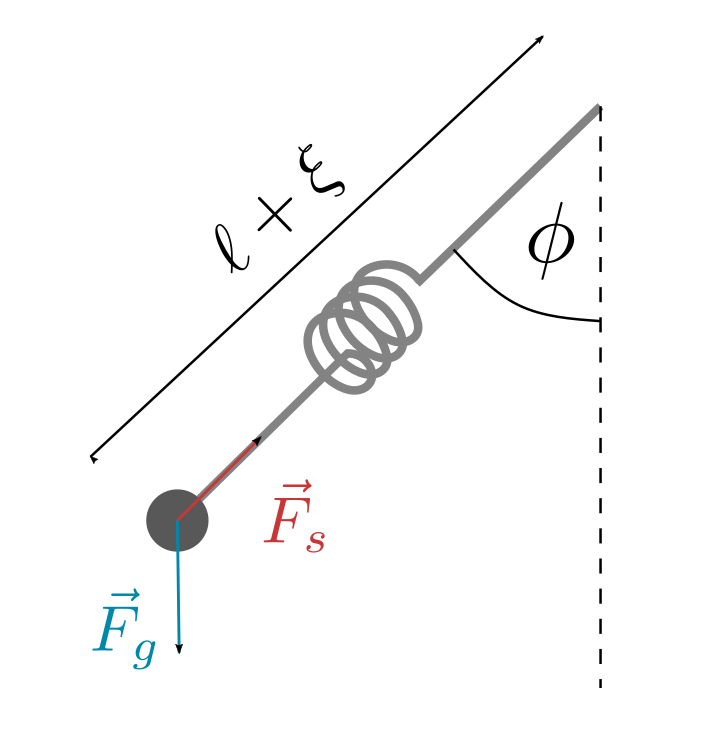
objectThe hamiltonian of a coupled oscillator. The coupled oscillator consist of mass attached to a spring. The movement of the mass is two dimensional, so that the angle of the spring can also change.
Derivation#
Generalized Coordinates#
We describe the position of the mass with an angle \(\phi\) and the displacement of the spring with \(\xi\). The cartesian coordinates of the mass are then given by:
\[\begin{split}\boldsymbol r(t) = \left( \begin{matrix} x(t) \\ y(t) \end{matrix} \right) = \left( \begin{matrix} (\ell + \xi(t)) \sin(\phi(t)) \\ -(\ell + \xi(t)) \cos(\phi(t)) \end{matrix} \right)\end{split}\]where \(\ell\) is the rest length of the spring. We transform our system from the cartesian coordinates \((x, y)\) to the generalized coordinates \((\phi, \xi)\).
Forces and Potentials#
The spring force is given by:
\[\boldsymbol F_{\text{spring}} = -k \xi \frac{\boldsymbol r}{\| \boldsymbol r \|}\]where \(k(t)\) is a time dependent spring constant. Using \(F = -\nabla V\) we can find the potential of the spring:
\[V_{\text{spring}}(\xi, t) = \frac{1}{2} k \xi^2\]In addition to the spring force, there is a gravitational force acting on the mass. The gravitational potential is given by:
\[V_{\text{gravity}}(\phi, \xi, t) = m g y = -m g (\ell + \xi) \cos(\phi)\]where \(m(t)\) and \(g(t)\) are time dependent mass and gravitational acceleration, respectively.
Kinetic Energy#
To find the hamiltonian, we need to find the kinetic energy. The kinetic energy is given by:
\[T = \frac{1}{2} m \dot{\boldsymbol r}^2 = \frac{1}{2} m \left( \dot{\xi}^2 + (\ell + \xi)^2 \dot{\phi}^2 \right)\]where the dot denotes the time derivative:
\[\dot{f} = \frac{d}{d t} f\]Generalised Momenta#
The last step before we can write down the hamiltonian is to find the generalised momenta. These are defined as the partial derivatives of the lagrangian \(L = T - V\) with respect to the generalised velocities:
\[ \begin{align}\begin{aligned}p_\phi = \frac{\partial L}{\partial \dot{\phi}} = m (\ell + \xi)^2 \dot{\phi}\\p_\xi = \frac{\partial L}{\partial \dot{\xi}} = m \dot{\xi}\end{aligned}\end{align} \]Hamiltonian#
The hamiltonian of our system is given by the sum of the kinetic and potential energy:
\[H(\boldsymbol \pi, t) = T + V = \frac{p_\phi^2}{2 m (\ell + \xi)^2} + \frac{p_\xi^2}{2 m} + \frac{k \xi^2}{2} - m g (\ell + \xi) \cos(\phi)\]where \(\boldsymbol \pi = (\phi, \xi, p_\phi, p_\xi)\) is the phase vector of the system. We rewrite the hamiltonian and sort it by coupled and uncoupled terms:
\[H(\boldsymbol \pi, t) = H_0(\boldsymbol \pi, t) + \epsilon H_1(\boldsymbol \pi, t)\]where \(\epsilon\) is a scaling factor that determines the strength of the coupling. For \(\epsilon = 0\) we get the uncoupled hamiltonian and for \(\epsilon = 1\) we get the fully coupled hamiltonian. The uncoupled part is given by:
\[H_0(\boldsymbol \pi, t) = \frac{p_\phi^2}{2 m \ell^2} + \frac{p_\xi^2}{2 m} + \frac{k \xi^2}{2} - m g \ell \cos(\phi)\]The coupled part is given by:
\[H_1(\boldsymbol \pi, t) = - \frac{\xi (\xi + 2 \ell) p_\phi^2}{2 m \ell^2 (\ell + \xi)^2} - m g \xi \cos(\phi) \]Due to the high nonlinearity of the coupled part, the equation becomes hard to analyze. It can be simplified by assuming that the spring displacement is small compared to the rest length of the spring. And that the angle is small. This approximated hamiltonian is detailed in [TODO].
Hamilton’s Equations#
The tendency equations are given by the time derivative of the phase vector:
\[\dot{\boldsymbol \pi} = \frac{d}{d t} \boldsymbol \pi\]using the hamiltonian, we can write the tendency equations as:
\[ \begin{align}\begin{aligned}\dot{\phi} = \frac{\partial H}{\partial p_\phi} = \frac{p_\phi}{m \ell^2} - \epsilon \frac{\xi (\xi + 2 \ell)}{m \ell^2 (\ell + \xi)^2} p_\phi\\\dot{\xi} = \frac{\partial H}{\partial p_\xi} = \frac{p_\xi}{m}\\\dot{p_\phi} = - \frac{\partial H}{\partial \phi} = - m g \ell \sin(\phi) - \epsilon m g \xi \sin(\phi)\\\dot{p_\xi} = - \frac{\partial H}{\partial \xi} = - k \xi + \epsilon m g \cos(\phi) + \epsilon \frac{p_\phi^2}{m (\ell + \xi)^3} \end{aligned}\end{align} \]Uncoupled Solution#
We set \(\epsilon = 0\) to obtain the uncoupled system, further we assume small angles \(\phi\), such that
\[\sin(\phi) \approx \phi \]this will obtain the hamiltonian equations:
\[\dot{\phi} = \frac{p_\phi}{m \ell^2} \quad , \quad \dot{\xi} = \frac{p_\xi}{m} \quad , \quad \dot{p_\phi} = -mg\ell \phi \quad , \quad \dot{p_\xi} = -k \xi \]Combining them yields:
\[\ddot{\phi} = -\omega_\phi^2 \phi \quad , \quad \ddot{\xi} = -\omega_\xi^2 \xi\]with frequencies:
\[\omega_\phi^2 = \frac{g}{\ell} \quad , \quad \omega_\xi^2 = \frac{k}{m}\]these are the well known frequencies of the string pendulum and of the spring pendulum.
- __init__(osc_prop: OscillatorProperties) None[source]#
Methods
__init__(osc_prop)kinetic_energy(phase, time)potential_energy(phase, time)tendency_angle(phase, time)tendency_angle_momentum(phase, time)tendency_displacement(phase, time)tendency_displacement_momentum(phase, time)tendency_phase(phase, time)total_energy(phase, time)